
A step nearer…
Outdoor practice spaces

One thing I love about Italy is the extended possibility of practising yoga, meditation, writing, eating and, well, living everything outdoors for 8 months or more of the year.
Especially yoga outside.
There’s this concrete deck on the third terrace of the garden, 3m x 4m. The previous owner used it for an above ground pool and it had quite a nice, but rotting, wood surround. Marty removed all the wood and rusty nails a couple of weeks ago, and surprisingly the space opened out and felt freer than previously when I’d reluctantly been rolling out my yoga mat to try to form a relationship with the hard concrete floor.
Why are spaces important to me?
It’s about beauty and aesthetics, invitations in, and the feel of being somewhere special. Inside La Casa Del Cacao, I’ve delighted in styling the two guest rooms, matching all the soft furnishings with those left by the previous owner, my own brought from the UK and pictures, linens , wall hangings, occasional tables and lamps that Mum has given me as part of her move from our loved family home of 60 years to a delightful supported one bedroom apartment. Uncannily, everything fits, matches and just works.
Not so with my much yearned for outdoor yoga space. I thought last year when I started using the concrete deck that it would be better somehow. I mean, the view is everything. But I needed something more finished somehow. We found some bags with sand and large slate tiles, so spread the sand and lugged the tiles up to cover the concrete. It was ok but as we didn’t have any way to cut the tiles, the space shrank. I heaved the tiles away.
Maybe the fourth terrace, not this concrete, is the yoga Shala? Maybe we can grow a lawn there?
Last year, Marty’s friend, a garden landscaper, came to visit and we had some delightful days planning out a deck, an emotional shower area, a hot tub and storage.
Lovely on paper.
But nothing was ever committed to.
However, Mike, you gave me the inspiration to think about what the space was truly signifying and this was an important part of the process.
You mapped out what I thought I wanted.
Yet, here I was six months later, back to square one. A concrete deck with a gorgeous view, but not a place I enjoyed for yoga.
In Japanese philosophy the concept of space, I’d read, was interesting. A way of naming space was “Kukan” meaning (空間): The physical dimension of space viewed as an experiential container that comes alive only when inhabited or perceived by life. I wanted to invite this aliveness, but the space has to be inviting.
Concrete is too harsh.
Another Japanese term for space is “Ma”. I’d first heard this a couple of years ago from my somatics teacher, Gemma. Looking back at my notes from the session I’d written about Ma (間): The conscious space, gap, or pause between structural elements…an active breathing presence.
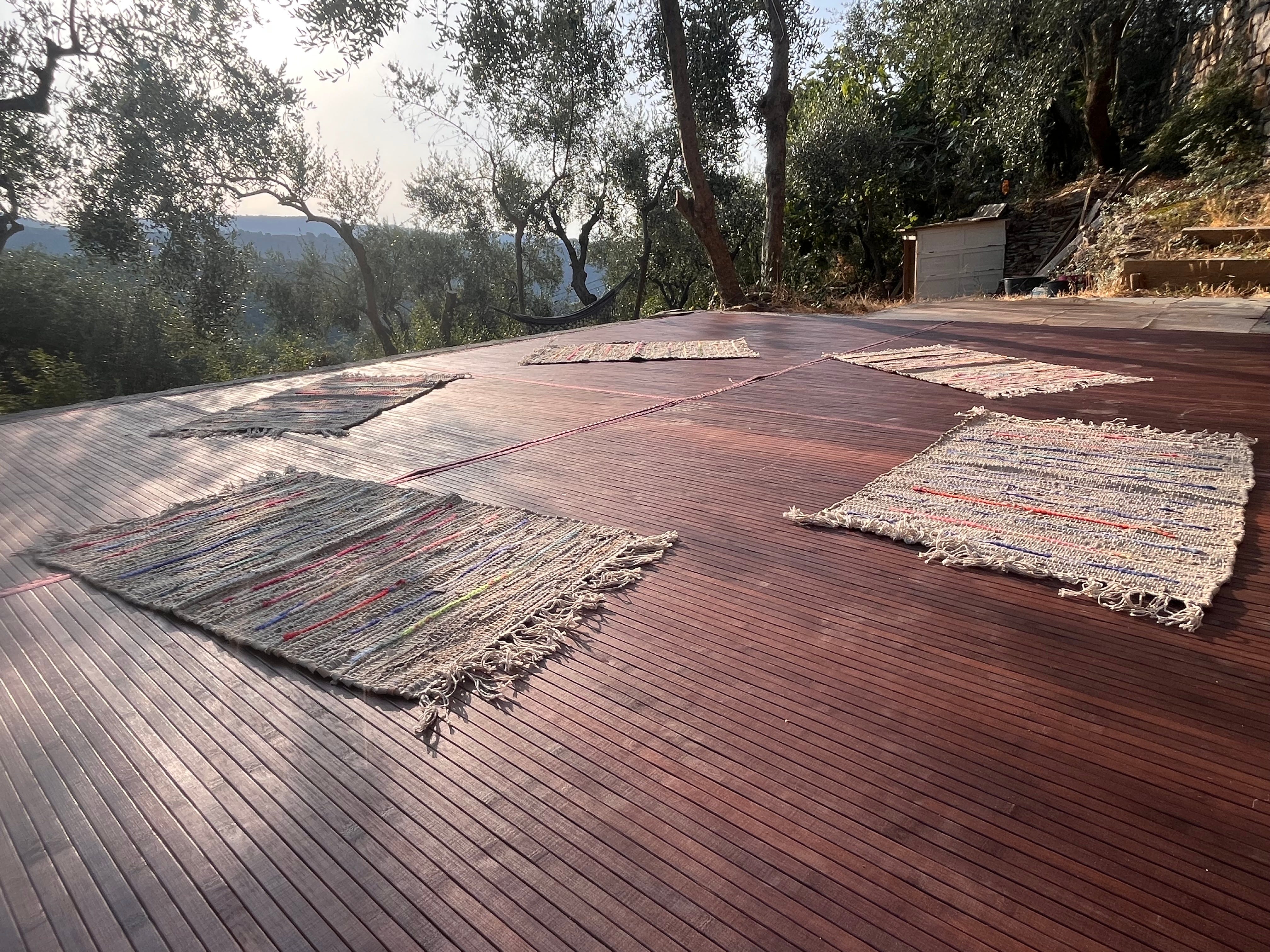
I started researching outdoor flooring. Tatami mats, plastic outdoor carpeting, coir, rubber, fake coir, rugs…aha! I hit on bamboo rugs as an option. The only option that seemed suitable for the rough concrete. I could try and if it didn’t work out I’d use them inside. I ordered two and then two more. A couple of sails for shade until the olives grow back (it was a hard prune this year) and two wooden outdoor trunks to store the yoga equipment.
The space is everything.
In yoga, the Hatha Yoga Pradipika, defines the physical attributes of a practice space to optimize energy retention.
The ideal room: It should be small, clean, level, and free from draft, insects, and noise.
The energetic boundary: A dedicated space acts as a containment field to prevent the scattering of vital energy (Prana).
The directional alignment: Practicing facing East (associated with the rising sun and new beginnings) or North (associated with spiritual stability) aligns the physical body with Earth's magnetic fields.
As I lay the last mat down, suddenly I see and know the shape of the space, and I want to practice.
I want to be in this space.
I want to share meditation with others in this space.
The four cardinal directions.
The sun rises directly over the mountains in front, the East. The solid traditional stone wall has our backs in the West. The North, past the two guardian olive trees, is the entrance; anticipation and focus. In Indian philosophy this entry is towards moksha, liberation, abundance, clarity and light. The North entrance also points to the head of the valley and the high Ligurian mountains beyond.
Mountains.
Of course, I see it all now.
The South and North can both function as exits and entrances, in fact, like in the pyramid temples of the Maya. At Chitzen Itza during the spring and Autumn equinoxes, the shadow serpent illusion called the "Descent of Kukulcán" is where afternoon shadows mimic a giant, slithering snake moving down the pyramid's northern staircase.
An altar to the four directions as a space to practice.
This is the aligning of intuition with practical necessity.
It’s just four bamboo mats, but they have created the space I knew was possible.
This…
Nice edition here:
https://www.yogavidya.com/hatha-yoga-pradipika.html
Your best yet (you’re actually too smart for me… while I play online chess you’re discovering life’s meaning lol!)